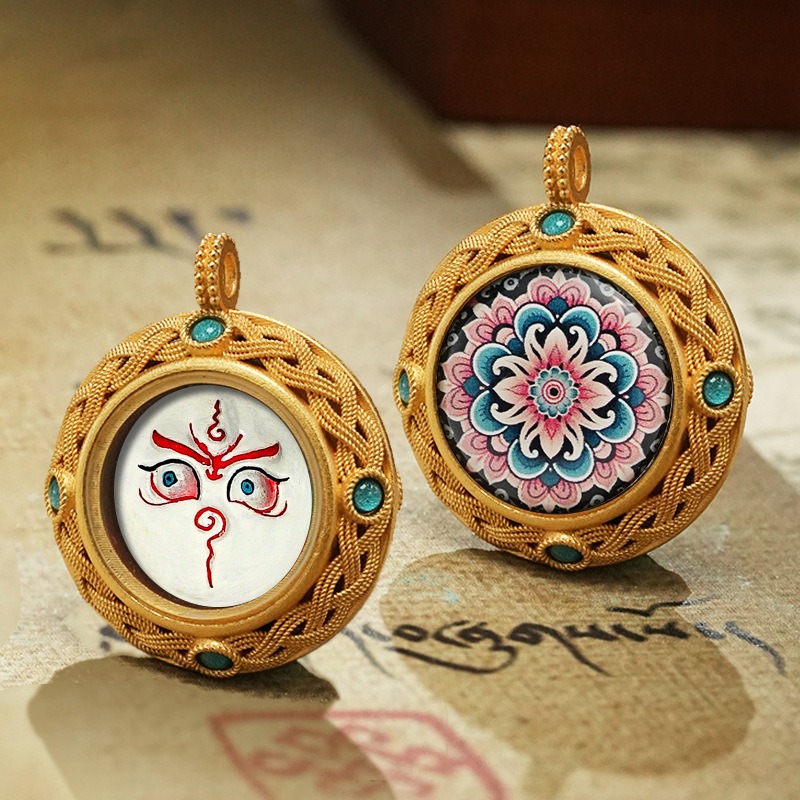
The Wisdom Eye (Skt. prajñā-cakṣus; Tib. ye shes spyan), also known as the “Buddha Eye” or “Eye of Enlightenment,” is a core symbol representing omniscient wisdom and awakened awareness. Its significance unfolds across multiple dimensions:
I. Symbolic Meanings of Five-Colored Wisdom Eyes
- Yellow/Gold Wisdom Eye
- Symbolism: Wisdom, wealth, luminosity, and supreme enlightenment.
- Representative Deity: Manjushri Bodhisattva (embodiment of wisdom).
- Functions:
- Enhances creativity and decision-making, supporting academic and career success.
- Attracts material abundance and elevates leadership authority.
- Contextual Use: Academic pursuits, professional development, critical decision-making.
- Red Wisdom Eye
- Symbolism: Vitality, courage, compassion, and purification.
- Representative Deity: Longevity Buddha (health preservation), Red Tara (dynamic life force).
- Functions:
- Dispels negative energies and wards off malevolent forces (e.g., red-eyed Dzi beads).
- Ignites action-oriented energy to overcome obstacles.
- Scientific Note: Red light spectrum stimulates emotion but may cause agitation if excessive.
- Green Wisdom Eye
- Symbolism: Healing, natural harmony, health, and prosperity.
- Representative Deity: Green Tara (protector of women and children).
- Functions:
- Balances physical and mental energy, alleviates stress and illness.
- Promotes longevity and familial harmony.
- Caution: Prolonged exposure to monochromatic green environments may suppress appetite.
- White Wisdom Eye
- Symbolism: Purity, obstacle-clearing, and wish-fulfillment.
- Representative Deity: White Tara (bestower of blessings).
- Functions:
- Purifies karmic obstacles and negative energies.
- Connects to the Ājñā chakra (third eye) in Vajrayana practice, facilitating meditation clarity.
- Black Wisdom Eye
- Symbolism: Protection, stability, and shielding against negativity.
- Representative Deity: Vajrasattva (fierce guardian).
- Functions:
- Defends against spiritual interference and psychic attacks (e.g., black-eyed Dzi beads).
- Anchors foundational energy, enhancing focus and security.
II. Functional Comparison of Five-Colored Wisdom Eyes
| Color | Core Symbolism | Representative Deity | Primary Functions | Applicable Scenarios |
| Yellow/Gold | Wisdom & Wealth | Manjushri | Academic/career advancement, decision-making | Exams, career planning, investments |
| Red | Courage & Purification | Longevity Buddha | Dispelling negativity, overcoming crises | Health recovery, competitive challenges |
| Green | Healing & Balance | Green Tara | Health restoration, familial harmony | Illness recovery, family reconciliation |
| White | Purity & Obstacle-Clearing | White Tara | Spiritual purification, goal attainment | Meditation, wish-fulfillment practices |
| Black | Protection & Stability | Vajrasattva | Energy shielding, mental focus | Stress management, crisis response |
III. Cultural and Spiritual Context
- Connection to the “Five Eyes” Realization System
- In Buddhist philosophy, the five colors correspond to progressive stages of spiritual insight:
- Physical Eye (human perception) → Divine Eye (transcendent vision) → Wisdom Eye (emptiness realization) → Dharma Eye (bodhisattva power) → Buddha Eye (ultimate enlightenment).
- Gold symbolizes the Buddha Eye, representing perfect omniscience.
- Artistic Manifestations
- Dzi Beads: Eye patterns (e.g., one-eye for focus, three-eye for mind-body-spirit unity) channel protective and prosperous energies.
- Thangka Art: White Tara’s third eye in thangkas is painted blue/white to signify karmic purification.
- Modern Adaptations
- Jewelry designs (e.g., brass pendants with Wisdom Eye motifs) blend esoteric symbolism with contemporary aesthetics, serving as daily reminders for spiritual mindfulness.